I'm not a poet. For the longest time, I thought I didn’t get poetry at all. I discovered that, well, of course I got poetry. I didn’t get all poetry, but I got music, I got prose, I got and I loved beautiful language in any medium, so of course I got poetry. To over-simplify it, if it made you feel something, virtually anything, then, you know, you get it. Whatever you got from it may not be what the author meant when they wrote it, but it made you feel, and in some small way it reminded you that you were human.
But anyway, I didn’t read much poetry, not intentionally, not until a few people who are, or were, close to me—people I still care about deeply, even if we don’t speak much anymore—shared their poetry, just with me. There’s a vulnerability, a depth of feeling in a poem, that’s unlike other mediums. This recognition opened a door, at which point I started, sporadically, reading more poetry. Mary Oliver and Wendell Berry, Jim Harrison and Robert Vivian. Allen Ginsberg, Sylvia Plath. These are a handful of the poets who speak to something inside of me, who remind me that I’m human, remind me that we’re all sharing this strange collective experience.
(My favorite poem is Tell Me a Story by Robert Penn Warren. Stops me in my tracks. Every. Single. Time. Do yourself a favor and read it, then read it again, then close your eyes and just sit with it for a moment or two.)
I say all this to hedge a little, to express why I do believe in poetry, but that I, myself, most assuredly am not a poet. I don’t understand structure, I don’t know what’s allowed and what’s not (are there rules? I think so…not sure). I don’t know what scale or meter mean in the context of poetry. I hardly know what a stanza is.
Nonetheless, despite all this, despite my insistence upon writing prose and only prose…I wrote a poem. I've written a few in my life, most of which are read by no one but myself, and without fail they're written swiftly, furiously, finding their final, amateur, not-very-good-and-often-melodramatic form in ten, fifteen minutes or less. This poem was no different. I wrote it over an old fashioned after seeing Union County at the Kenworthy Theater in Moscow, Idaho (happy 100 years, Kenworthy! Go support your old indie theater if you're lucky enough to have one!).
The reason I decided to share this poem is because I think it’s timely. I know I'm not the only person who is struggling with phone addiction, struggling with the hold it has over all of us (whether we want to admit it or not). I've recently been working on a new novel, and while it's emerging in spurts, I've realized that while my prose, at the line level, has improved, that I've gotten better at writing beautiful sentences, I'm struggling to mine deeply into ideas, feelings, to go beyond the shallow end of a scene or piece of exposition, because my attention is so easily interrupted, interrupted by this internal alarm, a repetitive worry, a reflex to check my phone.
And I’m not talking about ignoring a buzz or a ding. I made a habit of silencing my phone years ago (to the dismay of my mother whose calls I regularly miss), but no worries to big tech, because the ding or the buzz seems to have fused with my brain in the form of a recurring reminder to check my phone every few minutes, see if I’ve missed something. And, once I’m on it, and that first vertical video hits me, it’s almost impossible not to flip to the next, and the next, and the…So, when I’m trying to write I often put my phone in a completely different room, or if I’m at a café I stuff it in the bottom of my bag, or put it out of sight, face down, so it’s not staring at me. Nonetheless, that internal alarm remains, and it interrupts my thoughts, and the longer I ignore it, the louder it gets. Again, and again, and again.
The siren call of the technology that permeates our lives, that wants our attention so badly, is no longer just out there, but it has re-wired our brains—mine, at least—in a way that has seriously hampered my ability to find flow. Flow, that most important and blissful and substantive of mind-states, where time slips away and deep work, important work, soul-nourishing work, is done. And where I really notice this, my struggle to find flow, is in writing first drafts, where I may write six, eight, ten pages about something, exploring every nook and cranny of an idea, even if only a page, or a handful of paragraphs, come out of it in its final form. In order to find that page, those few paragraphs that contain the nexus of the deep work I did in the drafting stage, I have to go far beyond the shallow banks of an idea, and swim out into the deep end.
This isn't always easy to just do. Occasionally I fall into it without much effort, but that’s exceedingly rare. In fact, it can be quite difficult, and is a mind-state that, under the best of conditions, often requires some mental gymnastics to reach. It requires a certain temporary disconnection from the physical, from my sense of time. It requires not looking directly at the thing I want to write about, lest the thing scurry away and hide in the recesses of my mind. It requires a falling away of everything around me for an hour or two, only to suddenly wake from the fever I was in.
And it’s the emergence from a creative fever—a state of flow—that’s one of the best feelings in the world. Anyone whose taken psychedelics would describe this as the "after-glow". A blissful, sometimes almost euphoric, feeling of equanimity after the end of a bout of deep focus, creation, or complete immersion in an experience. The same state is achieved in religious contexts, deep prayer delivering—I would assume—a similar feeling. Among many other examples, I’m sure.
As a writer, this feeling, and the desire to think deeply, and write substantively, about my experience is not only something I like to do, it’s something I need to do. Christopher Hitchens put it aptly: “It must be the thing you feel you have to do. It must be that without which you could not live.” I wouldn’t go as far as arguing that all writers must feel this way, but it is exemplary of my relationship with the craft. And it pains me to recognize my waning ability to find those depths, to reach those mindstates required to write and think the way I want to write and think. I feel fear, too. Fear of what the apparent atrophy of my ability to focus, to pay attention, means to my worth as a writer, as a human.
So, in drafting the poem—that I’m still holding hostage until the end of this preamble—when the line, "a siren of never-ending" appeared on the page, it stopped me. It called to mind the Siren, the beautiful singing creatures of Greek mythology, whose songs and beauty would lure sailors in to shore, only to see their ships bashed and sunk on hidden rocks (or, if you watched Nolan’s adaptation of Homer’s The Odyssey, you know the scene I’m talking about). I'm sure I'm not the first to have drawn this parallel, between the tantalizing pull of technology that’s been designed to addict us, to bring us pleasure and elation, to use our hunger and lust and desire to feel seen and wanted and loved against us, and our own knowledge that this thing is hurting us, hurting our ability to connect with reality, connect with our loved ones in real life, to achieve true intimacy, and to think deeply and earnestly in the ways that make us human. And despite this, despite recognizing the ways that overusing this technology is making us less human, we still can’t resist it. I can’t resist it. I’m working on moderating my consumption, my interaction with it, but it is so, so goddamn hard to resist the temptation it presents in myriad ways, and impossible to live in a world where its use, its importance to how normal people function in society, is ubiquitous.
(I’ll also add that I don’t consider myself a luddite, nor am I arguing we should all throw our phones away and go off in the hills and lives as hermits (although…). In other words, I don’t want to make a complete boogieman out of technology that isn’t all bad. But much of it, much of how it is designed to addict us, is bad, and I believe it’s pervasiveness is a growing blight on our culture.)
All to say, my relationship to this technology is something I'm working on. I’m trying to re-gain control of my attention, of my ability to focus on something for longer than a few minutes at a time, to try and undo some of the re-wiring that’s occurred in my brain. And given the pervasiveness of this issue, an issue that’s only going to get more and more salient as we drive forward into the brave new world of AI, I thought I'd share this little poem. It’s probably not very good, but that’s ok. If you made it this far, at least I got you thinking about the topic, and that’s all I really care about.
A Siren of Never-Ending
I find myself yearning
Yearning for things, people
Spending time alone
But never really alone
With this phone
A siren of never-ending
And I find myself obsessed with my
Perceived loneliness
My aloneness, and I think
I think maybe I shouldn’t trust that voice
Trust it’s incessance
It’s persistent worry, want, lie
I think what I really want
What I really need
Is stillness
Stillness, quiet
Solitude
Boredom
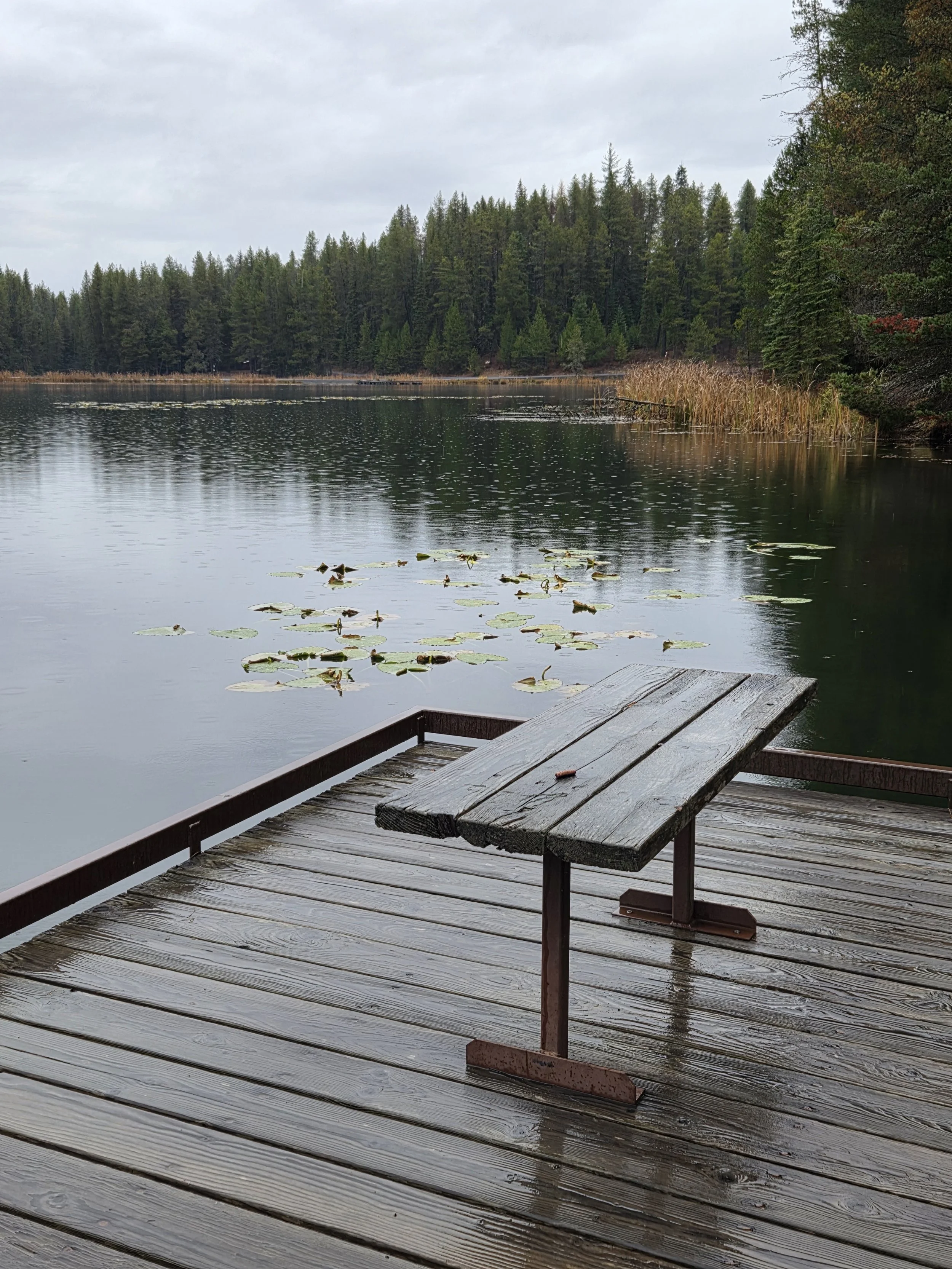
P.S. - If you like seeing my amateur photography, and maybe getting some little writing excerpts, feel free to give me a follow over on Instagram @brent.atkinson, where I post anti-content (i.e. - you’re not seeing my face and will probably never see a video, just good old fashioned amateur photography from the Pacific Northwest, accompanied by some words from yours truly).
